



We'd Love to Hear From You
We're here to provide you with the support you need.
Whether you have questions or require assistance, our team is ready to help.
Complete the form below, and we'll respond within 2 business days.
What Our Partners
Are Saying
The people we serve say it best.
Flourishing isn’t just a philosophy—it’s a measurable outcome. We are proud to partner with forward-thinking school districts and organizations that prioritize the human story as the foundation for collective success.
From staff rooms to boardrooms, our partners are seeing how intentional scaffolding transforms individual potential into lasting institutional strength.
The Leader's Perspective
Mona Cooley
CEO, Cool Family Solutions

Dr Wayne Hammond’s Flourishing Life Questionnaire has been instrumental in measuring the impact of our program. It has provided the participants in Cool Family Solutions 10-week Families Helping Families program to assess their individual growth areas and strengths. This strength-based approach provides valuable insights to empower families not only to cope with challenges but to thrive with confidence, adaptability, and a proactive mindset.
The Educator's Perspective
Tina Clem
Strategy, Evaluation & Impact Specialist,
Calgary Youth Justice Society
"In The Lead has made a difference in my life by guiding me to make better decisions and choices based on my strengths. I got to learn about some strengths I didn’t even know I had. This has made me a more open minded person and I have developed a growth- mindset."
- Youth Participant
It represents everything you believe in and have worked so hard to create and put out in the world.
Stay Connected. Keep Growing.
Flourishing is a journey—and we’re here to walk it with you.
Join our newsletter for the latest insights, tools, and stories to help you, your team, and your organization thrive. You'll also get access to new blog posts exploring emotional health, leadership, personal growth, and purpose-driven culture.

A Paradigm Shift From Good to Great
A Paradigm Shift From Good to Great
Using organizational challenges to grow strength, capacity, and long-term readiness
High-performing organizations are not defined by the absence of challenges. They are defined by how they respond to challenges—and what they become because of them.
The Flourishing Advantage (FA) model is built on a simple but powerful and transformational truth:
Fixing a problem may restore stability today.
Strengthening capacity prepares the organization for tomorrow.
This distinction is what separates organizations that remain good from those that become great, and stay there.
A Critical Reframe
A strengths-based approach is often misunderstood.
It is not about ignoring problems.
It is not about avoiding hard conversations.
And it is not about lowering standards.
Instead, the FA model was designed for organizations facing real pressure, complexity, and change. It helps leaders move beyond reactive problem-solving toward intentional capacity building.
When challenges are treated only as problems to fix:
solutions are often short-term
learning is limited to the immediate issue
teams rely on leaders to intervene again next time
When challenges are treated as opportunities to build strength:
leaders develop people, not just plans
teams gain confidence and ownership
the organization becomes more adaptable over time
Fixing problems stabilizes the present. Building strengths prepares the future.
The Thriving Perspective and Leadership Role
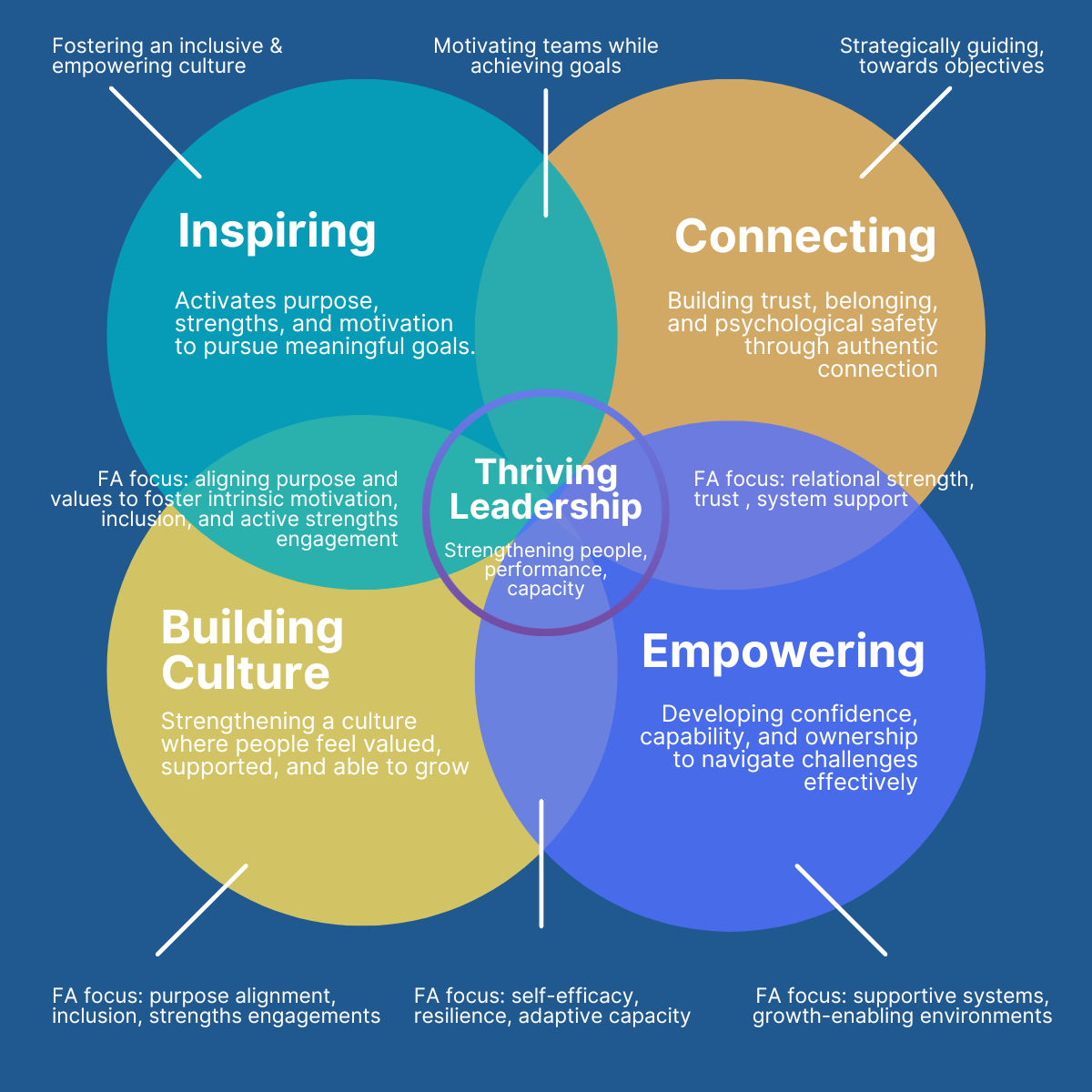
The FA Model does not bypass challenges.
It uses them deliberately to strengthen the human capacities required to navigate complexity well.
Across organizations, the pattern is consistent:
Challenges expose capacity gaps
Strengths development closes those gaps
Outcomes improve sustainably
Each challenge becomes a developmental moment, leaving the organization stronger than before.
How Leaders Actualize the Four FA Domains
Real Organizational Examples
1. PERSONAL WELL-BEING STRENGTHS:
When Pressure Reveals the Need for Greater Internal Stability.
Common Challenge:
During rapid growth or sustained operational strain, leaders notice rising fatigue, irritability, and decision overload. Absenteeism increases and reactivity becomes the norm.
Traditional Response (Fixing the Problem):
Add temporary resources
Push through deadlines
Introduce short-term wellness initiatives
FA Reframe:
Leaders treat pressure as an opportunity to strengthen emotional regulation, resilience, and confidence under stress.
Leadership Actions
Normalize conversations about pressure and decision fatigue
Model calm, grounded leadership under strain
Build routines for reflection, recovery, and clarity
Outcome
Better decisions under pressure
Teams remain focused rather than reactive
Greater readiness for future high-demand periods
2. RELATIONAL & SUPPORT STRENGTHS:
When Tension Signals a Need for Stronger Trust and Connection
Common Challenge:
Silos emerge, trust erodes, and conflict becomes personal rather than productive.
Traditional Response (Fixing the Problem):
Address individual conflicts
Reorganize reporting lines
Enforce communication protocols
FA Reframe:
Leaders view tens as a signal to strengthen trust, communication, and psychological safety.
Leadership Actions
Create structured spaces for open dialogue
Clarify shared goals and mutual accountability
Model respectful disagreement and curiosity
Outcome
Problems surface earlier
Collaboration replaces defensiveness
Cross-functional challenges are solved faster
3. LEARNING CAPACITY STRENGTHS:
When Change Exposes the Need for Greater Adaptability
Common Challenge:
New systems or strategic shifts trigger resistence, mistakes, and disengagement.
Traditional Response (Fixing the Problem):
Increase training and compliance
Attribute resistance to attitude or capability
FA Reframe:
Leaders treat disruption as an opportunity to strengthen adaptability, learning agility, and feedback capacity.
Leadership Actions
Frame change as a learning process, not a test
Encourage experimentation and reflection
Reinforce that mistakes are part of growth
Outcome
Faster adoption of change
Increased confidence navigating uncertainty
A culture that learns rather than resists
4. PERFORMANCE STRENGTHS:
When Execution Gaps Reveal the Need for Greater Consistency
Common Challenge:
Strategy is sound, but execution is uneven. Priorities shift and follow-through weakens.
Traditional Response (Fixing the Problem):
Add metrics and oversight
Increase reporting
Apply corrective measures
FA Reframe:
Leaders see execution gaps as an opportunity to strengthen focus, follow-through, problem-solving, and reliability.
Leadership Actions
Clarify priorities and reduce noise
Align expectations with available capacity
Build problem-solving habits rather than blame
Outcome
More consistent execution
Greater ownership at all levels
Performance that holds under pressure
Why This Approach Builds Great Organizations
Across all four domains, the outcome is the same:
less reactivity
stronger leadership consistency
teams capable of navigating complexity
reduced burnout and repeated crisis management
Problems solved in isolation prepare organizations for yesterday. Strengths built through challenge prepare organizations for whatever comes next.
A More Enduring Way Forward
The Flourishing Advantage Good → Great process offers leaders a practical, human-centred, and future-ready path to growth, by treating challenges not as disruptions, but as opportunities to strengthen the organization's people, culture and capacity to thrive.
Good is where you start.
Great is what you build.
Flourishing is what endures.
🧭 Next Steps:
Ready to grow from good to great?
Take the first step - connect for a discovery session



© 2026 Flourishing Life Technologies, Inc.
All Rights Reserved